

It’s a question that comes up frequently: are carbon catamarans loud offshore?
The concern is understandable, and it often stems from two sources:
- Sailors with experience on offshore carbon racing monohulls
- Conversations within the performance sailing community where strong opinions tend to circulate
But the short answer is: no, carbon catamarans are not inherently noisy in the way many people expect.
Disclamer: I am discussing performance boats in this topic, not the charter versions with wide polyester hulls
Where the Perception Comes From
To understand the concern, it helps to look at the evolution of high-performance carbon monohulls.
In the early 2000s, there was a clear shift in design and engineering. Boats became:
- Significantly lighter
- Structurally more refined
- Equipped with more powerful rigs and lighter sail plans
This combination pushed speeds dramatically higher. At the same time, hull shapes—especially flat sections forward—were optimized for planing performance.
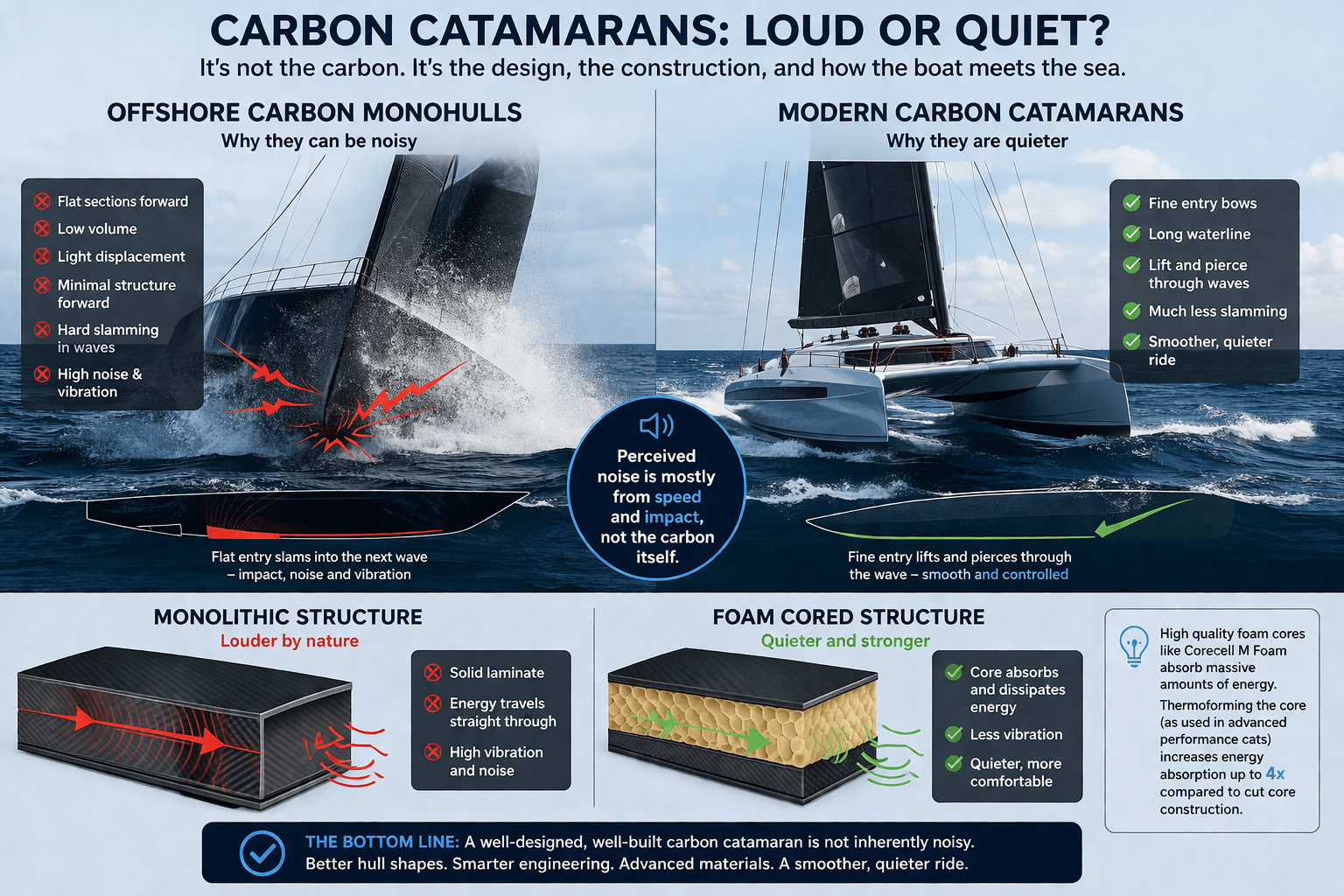
The result? When these boats hit a seaway at speed, they could slam hard. The impact of a flat, lightweight carbon hull landing on the next wave—often with minimal internal framing forward—produced extreme noise. Even experienced sailors found it unsettling.
That experience has shaped how many people think about carbon construction in general.
Long story short: IF carbon boats are louder, it's because they are faster. And that's lineair: same speed, same noice. Double the speed, double the noice. But hey 😉
Ron Spoelstra
Why Catamarans Are Different
Carbon catamarans behave very differently from these monohulls.
Key design differences include:
- Slender hull shapes with finer entries
- Greater overall length relative to displacement
- Reduced need for flat planing sections forward
Instead of slamming into waves, a well-designed catamaran will:
- Lift more gradually
- Slice through wave troughs
- Maintain a more level motion
As a result, slamming is significantly reduced, and with it, the associated noise.
Material vs Design
Another common misconception is that carbon itself is the cause of noise.
In reality, material choice is only part of the equation.
What matters more is:
- Hull shape and weight distribution
- Structural design
- Core materials used in construction
For example:
- A monolithic laminate (solid glass or carbon) transmits energy directly, which can amplify sound and vibration.
- A foam-cored structure—common in high-end catamarans—absorbs and dissipates energy far more effectively.
Modern cores such as high-quality structural foams are engineered specifically to:
- Increase stiffness
- Reduce vibration
- Improve overall comfort onboard
Advanced techniques like thermoforming further enhance these properties by improving load distribution and energy absorption.
What Actually Creates Noise
When people describe a “noisy” carbon boat, they are often hearing:
- Water noise from speed, not structure
- Impact from hull shape, not material
- Resonance from poor construction, not carbon itself
In fact, a well-built carbon catamaran may feel quieter and more solid than a heavier, less refined boat.
The Bottom Line
Carbon catamarans are not inherently noisy. The perception largely comes from experiences with a very different type of vessel—ultra-light, flat-bottomed racing monohulls operating at high speeds.
In contrast, performance cruising catamarans:
- Use more forgiving hull shapes
- Benefit from advanced composite engineering
- Deliver a smoother, quieter motion at sea
As always in yacht design, execution matters more than material alone.